
Western Sydney's Energy Problem Is a Commercial Opportunity — If Anyone Steps Up
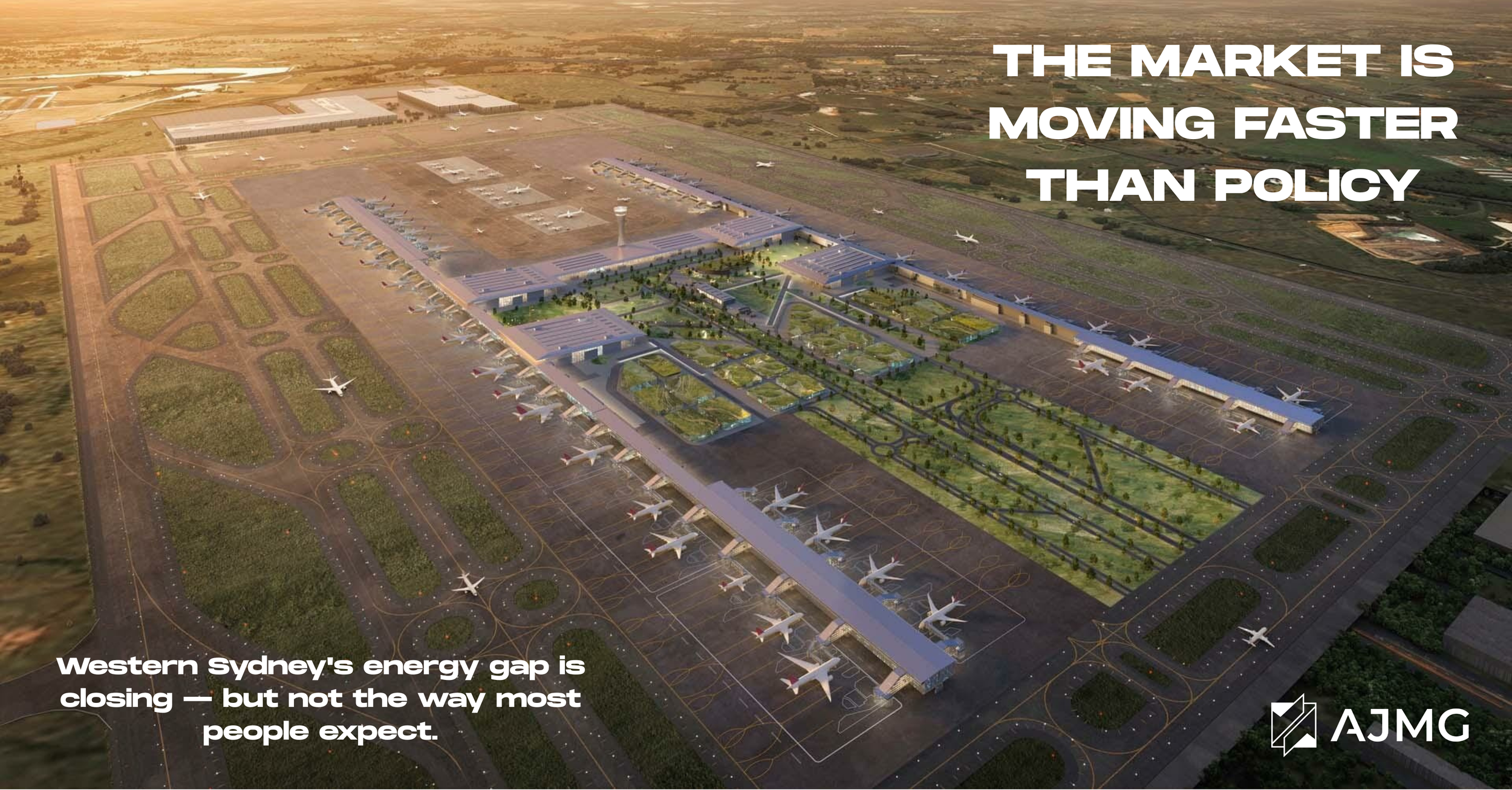
Western Sydney is one of the largest urban growth stories in the southern hemisphere right now. Greater Western Sydney, already home to 2.5 million people, is projected to absorb two-thirds of Greater Sydney's total population growth and reach 3 million people by 2036. Camden is currently the fastest-growing LGA in the entire state, with Wollondilly not far behind. Both feed directly into the Aerotropolis corridor.
The Western Sydney International Airport has completed major construction — terminal, 3.7km runway, roads, utilities — and is on track to open for domestic and international operations in late 2026. Since rezoning, the Aerotropolis has triggered close to $26 billion in committed private sector investment, with 18,000 construction jobs active and somewhere between 120,000 and 200,000 future jobs underpinning the precinct's long-term trajectory.
Transport links, roads and schools will absorb the policy attention. But there's a layer of infrastructure almost nobody is talking about seriously: energy.
And that silence is either a policy failure or a commercial opportunity, depending on where you're sitting.
The Grid Edge Problem Is Already Here
Western Sydney sits at the edge of a transmission and distribution network designed for a different era. Endeavour Energy's infrastructure in the west was built to serve a region that looked nothing like the one being constructed right now.
The load arriving is not incremental. Large-scale warehousing, cold chain logistics, data centres, EV charging for the freight fleets servicing the Aerotropolis and Port Botany corridors, and increasingly hyperscale digital infrastructure. Goodman has filed for environmental assessment of Project Atlas: a proposed A$5 billion, 500 MW data centre campus at Eastern Creek, adjacent to an existing 200 MW CDC facility. NextDC and OpenAI have announced a hyperscale campus at the S7 site in Eastern Creek, with Phase 1 targeted for H2 2027. These are not residential loads. They are industrial-scale draws on infrastructure that was never designed to carry them.
The official engineering assessment is unambiguous. A May 2024 Transgrid and Endeavour Energy consultation report for the Western Sydney Priority Growth Area found that grid capacity is expected to be exceeded from 2026/27 under system normal conditions, and that without augmentation costed between $132 million and $258 million, there is insufficient sub-transmission and distribution capacity to sustain development beyond the near term. That is the network operator's own assessment, not an industry anecdote.
Grid augmentation will happen, and some of it is already in planning. But it's slow. For complex commercial and industrial connections requiring network augmentation, real-world timelines materially exceed statutory minimums. In a region growing this fast, multi-year connection delays are a structural constraint with a defined breach date, not a minor inconvenience.
The NSW Transmission Planning Review Final Report, released October 2025, found that timely delivery of major transmission projects is currently a significant challenge across Australia, with material delays recorded on many large projects. The gap between what the grid can deliver and what the market demands is not closing on its own.
The Case for Distributed Energy — Made By the Market
The market is starting to solve this faster than policy is.
Distributed energy resources — solar, battery storage, DC microgrids, behind-the-meter generation — are increasingly the rational economic choice for large commercial and industrial users in grid-constrained locations. Not because they're ideologically committed to clean energy, but because the numbers work.
The institutional capital flowing into this space confirms the thesis. In July 2025, KKR committed AU$500 million to CleanPeak Energy, its first Asia-Pacific transaction under its Global Climate Transition strategy, specifically to scale distributed solar, battery storage, and microgrid deployment across Australia's commercial and industrial sector. CleanPeak's current operating footprint spans 40 MW of rooftop solar, 100 MW of utility-scale solar, and 35 MWh of storage, with a pipeline of 100 MW of solar and 300 MWh of battery capacity in development. Q1 2025 was the second-best quarter on record for large-scale BESS investment in Australia, with six projects worth AU$2.4 billion reaching financial commitment in a single quarter.
DC microgrid architecture is worth particular attention in the Western Sydney context. The industrial and logistics load profile here, high-demand, intermittent, increasingly co-located with solar and battery assets, is close to textbook for what a well-designed DC microgrid can optimise. Combining generation, storage, and consumption reduces grid dependency, improves resilience, and opens revenue streams through demand response participation. The technology is proven and the commercial models are maturing. In November 2025, Essential Energy, UNSW, and RACE for 2030 launched a collaborative project specifically targeting the reduction of regulatory barriers for connected and islandable microgrids within Australian distribution networks.
The missing piece is not the technology or the capital signal. It's the deployment, and the advisory capability to bring the technical, commercial, and capital dimensions together simultaneously. That is the infrastructure gap in Western Sydney in its most concrete form.
EV Charging Is the Forcing Function
The logistics build-out already underway in Western Sydney is extraordinary in scale. IFM Investors' $489 million Summit at Kemps Creek, eight large-format warehouses totalling 245,000 sqm, was approved in February 2026, with construction beginning later this year. Goodman acquired a 196-hectare site near the airport in August 2025, one of the largest land transactions ever recorded near the Aerotropolis, and has filed for a 600,000 sqm logistics superhub targeting anchor tenants including Amazon, FedEx, and Coles. GPT's Yiribana West on Mamre Road is already leasing, with base build solar and battery storage embedded in the design and a 5-Star Green Star target. ESR's Eastern Creek Logistics Estate, 98,000 sqm with approximately $500 million end value, completed Q4 2024.
The fleets that will operate out of these facilities are already under mandatory pressure to electrify. The Treasury Laws Amendment Act 2024 introduced the Australian Sustainability Reporting Standards, with phased mandatory Scope 3 emissions reporting that is now live. Group 1 entities, those with revenue above $500 million, assets above $1 billion, or more than 500 employees, entered mandatory Scope 3 reporting in their second year of disclosure, which begins in January 2026. Any logistics operator in the Western Sydney Employment Area supplying a Group 1 retailer or manufacturer is already providing Scope 3 data to that client. This is not a future obligation. It is a current legal requirement for the largest operators in the market.
The Electric Vehicle Council's open letter to Australian governments, published April 2026, is direct: the pilots are over. The call is for a national electric truck incentive scheme and harmonised road access. The NSW Government's 2026 Electric Vehicle Strategy, released this month with a $100 million commitment, specifically acknowledges the charging gap in outer suburban and industrial corridors as its first priority and expands the EV Fleets Incentive Program to include small and medium trucks.
The gap is acknowledged and the demand is materialising. The sites that solve this first, that get the right charging infrastructure in place with the right energy architecture behind it, will have an operational and cost advantage that is very hard to replicate later.
What "Stepping Up" Actually Looks Like
I'm not making the argument that Western Sydney's energy problem is simple, or that there's a single solution. The complexity is real: grid interface, planning approvals, technology integration, commercial structuring, capital raising. Some developers are already moving in the right direction. GPT's Yiribana West, with its embedded solar and battery storage, is an early signal of what best practice looks like.
But complexity is also why the opportunity exists. The projects that look too hard for a generalist are exactly the ones where specialist capability creates outsized value.
What stepping up looks like in practice:
For developers and asset owners: Treating energy infrastructure as a first-order design consideration, not a services afterthought. The projects that will command premium rents and long-term tenants are the ones with resilient, flexible energy systems designed in from the start, not retrofitted when grid constraints bite.
For energy technology companies: Understanding that Western Sydney's commercial and industrial growth is a decade-long deployment pipeline, and that the relationships and credibility built before the airport opens determine who captures the majority of it.
For capital: Recognising that distributed energy infrastructure in high-growth, grid-constrained markets is one of the more compelling risk-adjusted infrastructure plays available. The demand is structural, the returns can be structured, and the Transgrid/Endeavour Energy assessment gives you the precise year the grid runs out of headroom.
The Window Is Open — For Now
Western Sydney's energy infrastructure gap is not going to persist indefinitely. At some point, driven by grid investment, regulatory pressure, and competitive dynamics, the market will organise around it. Projects will get done. Infrastructure will get built.
The question is who builds the relationships, the credibility, and the deal flow now, before that market organises. The airport opens in late 2026. The grid capacity breach was projected for 2026/27. The Scope 3 clock for the largest logistics operators is already running.
I've spent the better part of two decades working across the built environment and energy transition, including on the founding team of Australia's first commercial EV charging network, from inception through to an institutional raise with a global infrastructure fund. The pattern I keep seeing is that the commercial opportunities in infrastructure don't wait for consensus. They close on the people who got there early.
Western Sydney is one of those moments.
Andrew Giannasca is the founder of AJMG Solutions, a Sydney-based strategic advisory firm specialising in urban decarbonisation, transport electrification, EV infrastructure, and built environment strategy.
