
Kerbside charging isn't a charging problem. It's a parking policy problem.
There is a particular kind of council meeting that happens about four months into an EV charging project. A sustainability officer is at the front of the room, working through a slide deck. There is a heat map. There are blue dots representing planned charger locations. Everyone is nodding. Greg from Waste is asleep. And then someone from parking — who has been quietly reading the agenda papers in a way that suggests they may have been reading them for the first time at that exact moment — looks up and says, "Wait. These are going in resident permit zones?"
And the nodding stops.
I have watched some version of this meeting happen more times than I would like to admit. The sustainability team has been working on the EV strategy for nine months. The parking team has been working on parking, which is what they always work on, because parking is an inexhaustible source of work in a way that EV charging will never be. The two teams sit two floors apart in the same building. They have not spoken. The discovery that they probably should have spoken arrives, on average, in month four. By month six it has produced a memo. By month nine the memo has produced a working group. By month eleven the working group has produced a recommendation that the EV strategy should have been a parking strategy all along, and now we are all going to have to start again with the people who write parking strategies, who are not the same people, and who have different feelings about meetings.
This is the situation I want to talk about.
I spent a few years building Australia's first commercial kerbside EV network, and the thing I expected to be the problem — the electricity, the technology, the operators, the grid — turned out to be the easy bit. What was hard was that almost every single conversation that mattered started with a question about parking and ended with a question about parking, and very few of them touched the chargers at all.
This is because kerb space, despite appearances, is not a neutral medium. It is a contested public resource, governed by a thicket of policy that mostly predates EVs by several decades. The kerb in front of any given Sydney apartment building is already doing multiple jobs. It is parking for residents who paid for a permit. It is loading for the delivery drivers who keep the suburb in groceries. It is access for taxis, marked space for people with disabilities, sweeping zones for council trucks, and intermittent space for the visitor who shows up at the wrong moment and is not subtle about the experience. Adding a kerbside EV charger to this arrangement does not create a charging program. It creates a sixth competing use of a finite resource, and the question of which use wins is a question that someone, somewhere, has already had an opinion about for forty years.
Most kerbside EV strategies do not engage with this. They are essentially procurement documents — how many chargers, what kilowatts, which operator, where on the map. The map gets drawn, the operator gets selected, and then the strategy crosses paths with parking policy somewhere around month four, and discovers it has a second half.
There are five questions in the second half. They are not glamorous. They are not the kind of questions that get a sustainability officer on a panel at All Energy. But they will determine whether the chargers in your council go live in eight weeks or eighteen months, and whether anyone uses them when they do.
Time limits. A two-hour parking limit makes a great deal of sense for retail turnover. It is a poor match for a 7kW AC charger that needs four to six hours to do anything useful. UNSW analysed roughly 27,000 charging sessions on the Eastern Suburbs kerbside network in 2026 and found that most users were topping up, not primary-charging, and that DC chargers paired with two-hour limits outperformed AC chargers on basically every metric that matters. Which means — and this is the unwelcome bit — that the charger technology decision and the time-limit decision are the same decision. They are not sequential. You do not get to make one and then make the other. They are entangled in a way most procurement processes do not handle gracefully.
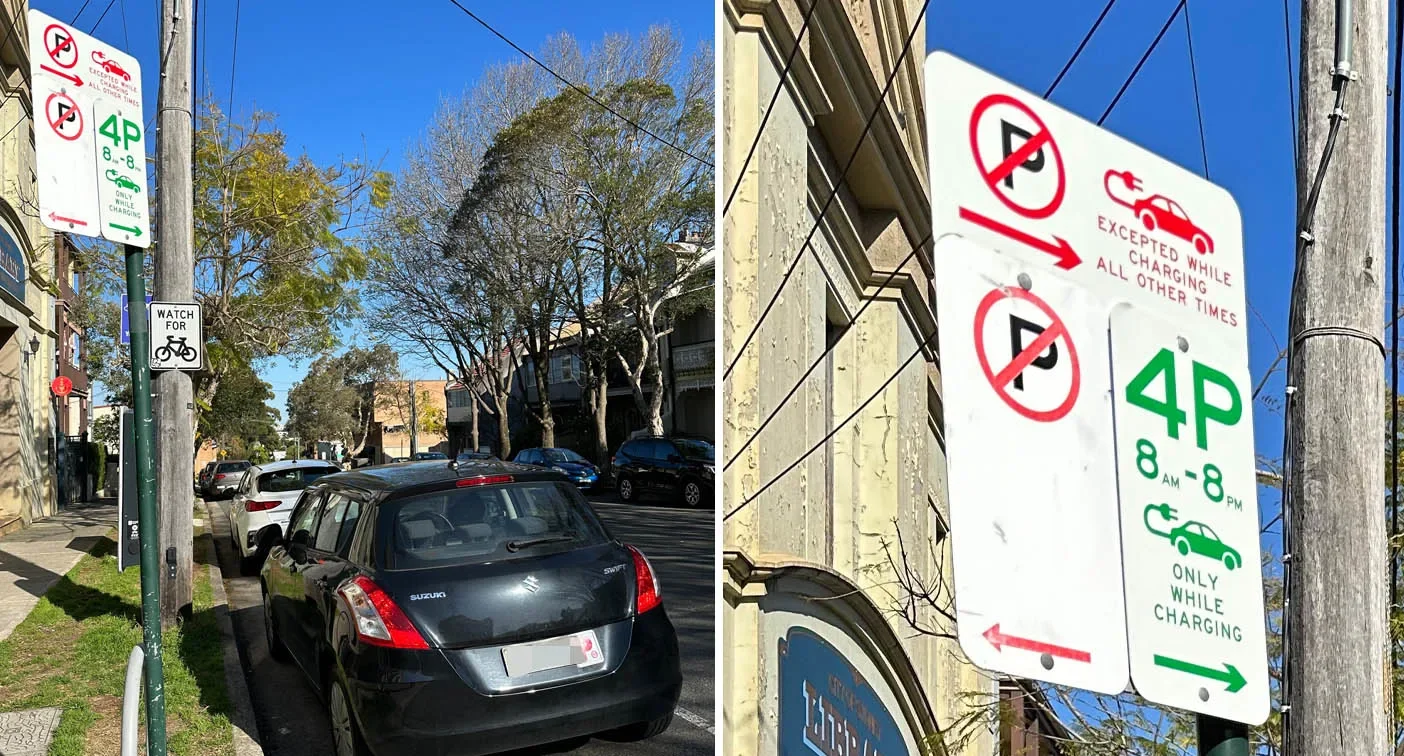
Permit zones. If a kerbside charger goes into a resident permit zone, who is allowed to use it? Anyone? The resident has lost a parking space without compensation. Permit holders only? The utilisation drops and the commercial case wobbles. There is no correct answer to this question, but there is a famously incorrect way to handle it, which is to leave the question unanswered until the chargers are physically installed and the first complaint arrives, which happens approximately ninety minutes after commissioning.
Pricing interaction. A council has, broadly speaking, two kinds of bays: priced and unpriced. EV charging introduces a third variable, and the variable does not interact cleanly with either of the existing two. If chargers go in unpriced bays, the council has effectively created a paid use of a free resource, which is the kind of thing that turns up in a Sydney Morning Herald op-ed three weeks later. If they go in paid bays, the meter system has to integrate with the CPO billing system, or it doesn't, and either way it is a procurement constraint before it is a strategy choice.
Enforcement. This one is my favourite, because the entire policy apparatus already exists and almost nobody uses it. The NSW Road Rules added two offences in November 2022. Rule 203B covers non-EVs parked in an EV bay. Rule 203C covers EVs parked in a charging bay without actually charging. Transport for NSW has issued about 466 fines under these rules in their first year of life. But — and this is the part — the offences only work where the correct signage has been installed in the correct configuration. The legislation requires the parking team to act before the law becomes operative on a given square of asphalt. Without that act, the rules exist in theory and have no effect in practice. Most deployed kerbside bays in NSW have not been through that process before opening. The category exists in law. Whether it exists on the street is a parking-team decision.
Hierarchy. When the kerb is over-subscribed — which it is, in every council I work with — which use wins? In most local environment plans, the answer is: whoever got there first. This is a hierarchy, but it is the hierarchy you would get if you stopped people in a doorway and let them sort it out by elbow.
None of these questions are exotic. They are the ordinary stuff of kerbside management with one new variable added. But the new variable lives in a different team to the existing variables, and the working assumption that the EV strategy is a parallel project to the parking policy is where most of the friction begins. It is also, eventually, where it ends.
The structural move is to stop treating kerbside EV charging as a charging program and start treating it as a parking use. Same governance, same priority logic, same hierarchy decisions. The chargers and the kilowatts and the operators are second-order questions. The first-order question is whose policy framework owns the kerb, and what it currently says.
A defender of the procurement-first approach would, at this point, point out that getting infrastructure in the ground does in fact generate utilisation data, build political momentum, and create the conditions for the parking-policy work to follow. The Eastern Suburbs network grew from 75 charging spaces in 2023 to over 300 by mid-2025, and the UNSW study exists at all because that infrastructure existed first. This is a fair point. The failure mode I am describing is not procurement-first. The failure mode is procurement-only — the second half of the work that gets parked and never picked up.
The good news, to the limited extent there is good news, is that the parking conversation will happen anyway, because the kerb forces it. Every council that has built a network of any size has had to confront the parking question, usually around month nine, usually under conditions less favourable than they would have liked.
The choice is not whether to have the conversation. The choice is whether to have it before the strategy is adopted, or after the first complaint letter.
I know which one I would prefer.
Andrew Giannasca is the founder of AJMG Solutions, a Sydney advisory firm working with councils on transport electrification and kerbside infrastructure. He was on the founding team at JOLT Charge, Australia's first commercial EV kerbside network.
