
We spend more than $10 billion a year making diesel cheaper.
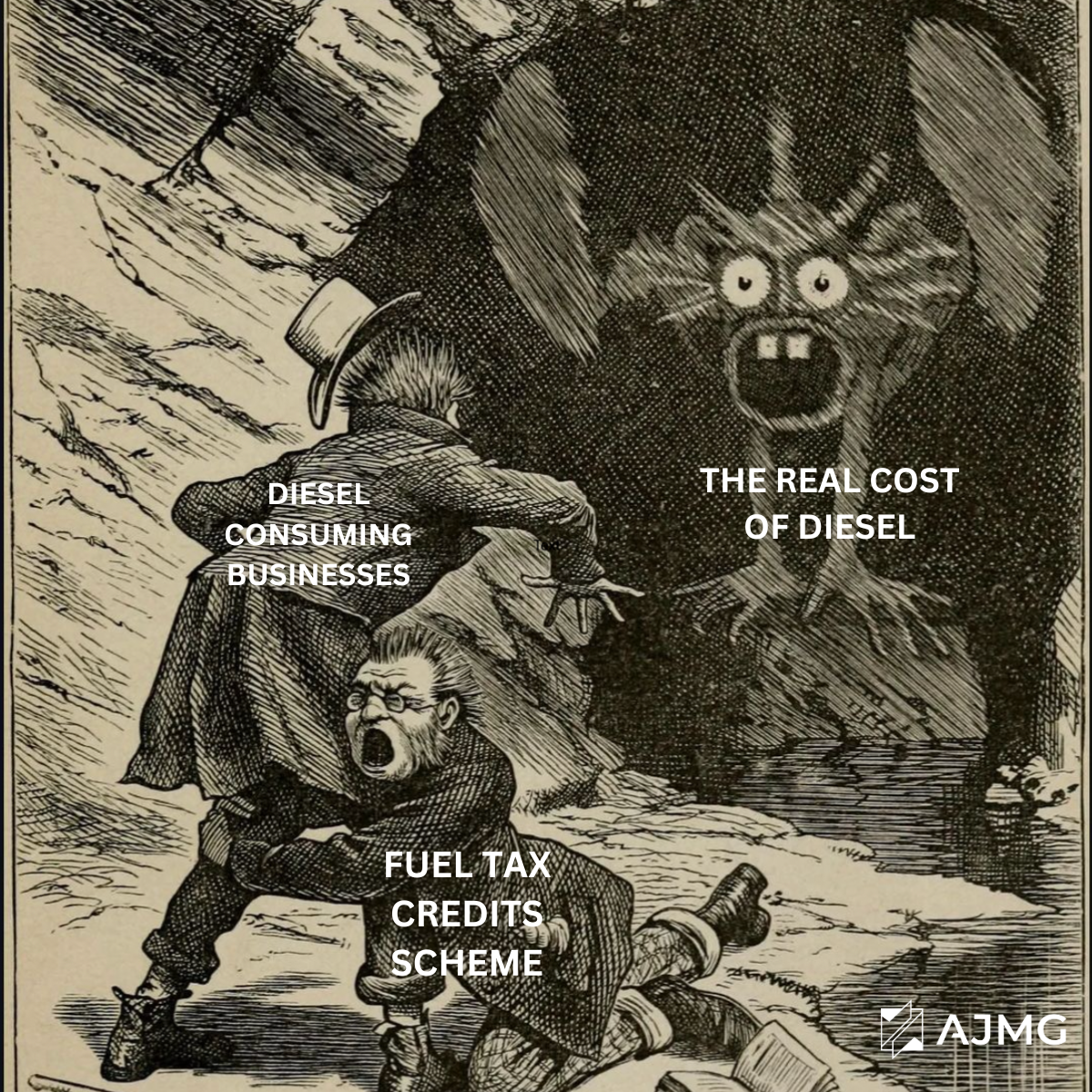
I want to tell you about the most powerful piece of energy policy in Australia, and I am fairly sure you have never heard it raised at a dinner party, a conference, or anywhere else a reasonable person spends time.
It is called the Fuel Tax Credits Scheme. It is not a scandal. Nobody is being defrauded, nothing is being hidden, and it is administered with the quiet competence of a program that worked out long ago that the surest way to avoid scrutiny is to have a boring name. It is also, comfortably, the largest fossil fuel subsidy in the country — though, as we'll get to, the word "subsidy" is itself a small war. This financial year it is forecast to hand back about $10.8 billion to the businesses that claim it, and the budget has it climbing past $13 billion by the end of the decade.
The mechanism is the whole story, so let me walk through it.
When you buy diesel in Australia, the price includes an excise — a tax of about 52 cents a litre — which exists, at least in theory, to make you pay for the roads you use and the mess you make. (I say "in theory" because road funding hasn't actually come out of fuel excise since the 1950s; almost all of it now disappears into general revenue. Hold that thought.) If you're a business burning that diesel, you can claim some or all of that excise back. How much depends on where you burn it.
For off-road users — miners, farmers, quarry operators, anyone running diesel through stationary plant or across private land — the credit returns the full excise. Their net fuel tax is, effectively, zero. This is where most of the money goes: the mining industry alone takes close to half the scheme, somewhere around $4.8 billion of it, with the coal sector's share running to roughly $1.4 billion a year.
For on-road heavy vehicles — the long-haul trucks behind most of our non-bulk freight — it's more modest. They get a partial credit, because a separate road user charge is netted off first, leaving a benefit of around 20 cents a litre rather than the full 52. Still real. Still a deliberate discount on diesel that never appears as a subsidy on anyone's books. Just smaller than the headline number implies.
Add it together and the net effect — and I want to be precise, because the effect is the entire point — is that the Australian government spends more than ten billion dollars a year making diesel cheaper for the businesses that use the most of it.
I should deal with the word "subsidy" here, because the moment you use it, someone — often the people receiving the money — will tell you it's nothing of the sort. The government's position, and the Productivity Commission's, is that this isn't a subsidy at all: it's the removal of a road tax from fuel that isn't used on public roads, no different in principle to not charging GST on a business input. It's a fair point, and on the off-road logic it holds up. It holds up less well once you remember two things: road funding stopped coming out of fuel excise about seventy years ago, and the credit is paid to on-road trucks too, where the "they don't use the roads" argument plainly doesn't apply. The OECD and the IEA both count it as a fossil fuel subsidy. Reasonable people genuinely disagree. I'm comfortable calling it one — but you can mentally substitute "the diesel discount" throughout if you'd rather, because the effect on the numbers is identical.
Here is where it gets genuinely strange — and where I, as someone who spends his days trying to help fleets and councils go electric, start to feel like I'm watching two arms of the same government pulling against each other.
On one side of the building, we are spending public money to push the switch to electric. Charger grants. Low-cost finance for electric trucks. Strategies, roadmaps, ministerial media releases with the word "future" in them. The message could not be clearer: please, for the sake of the climate and the grid and the trade balance, electrify.
On the other side of the same building, we are spending more than ten billion dollars a year making the diesel alternative cheaper than it would otherwise be — several times over what we put toward accelerating the switch.
These two policies are not in tension in some lofty, ideological way. They are in tension on a spreadsheet. When a logistics operator sits down to work out whether to replace a diesel prime mover with an electric one — and I have sat in on versions of this conversation more times than I can count — one of the bigger entries in the "reasons to stay diesel" column is the running cost of the diesel. And that running cost is being held down, deliberately, by a federal program. The discount never shows up on the operator's books as a subsidy. It just appears as diesel costing a little less than the sticker excise implies, year after year, quietly improving the business case for doing nothing.
The thing I keep coming back to is that the scheme is not failing. It is working perfectly. It was built to make business diesel cheaper and it makes business diesel cheaper, with great reliability, every single year. The problem is not malfunction. The problem is that its purpose and the purpose of the entire energy transition are pointed in opposite directions — and the diesel side is, by a distance, the bigger number.
And it is not shrinking. The budget papers have the scheme climbing year on year, an increase they attribute, in the driest language imaginable, to an expected rise in the use of the fuels that qualify. Read that twice. We are forecasting that the diesel discount will grow — toward $13 billion by 2028-29 — in the very years we have told everyone the diesel is on its way out.
A fair objection at this point: as I write this, diesel is actually cheaper than usual, because the excise was temporarily cut by about 60 per cent from April to June this year after the oil price spiked. True — but set it aside. That cut is a three-month sugar hit aimed at the bowser and a Middle East supply shock; it reverts on 1 July, and it has nothing to do with the structural scheme underneath it. If anything it makes the point: when fuel politics gets urgent, we reach instinctively for the lever marked "make diesel cheaper." The Fuel Tax Credits Scheme is that same instinct, running quietly in the background, every year, forever.
None of this is to make the argument you might expect — that we should abolish the thing tomorrow morning. Strip it out overnight and you'd hammer farmers and remote operators who have no electric alternative yet and no way to absorb the hit. That's a real problem, not a debating point. The scheme isn't evil. It isn't even, on its own terms, unreasonable.
My point is narrower, and I think more useful. If you're a fleet operator wondering why the electric business case keeps coming out close-but-not-quite, this is one of the quiet reasons it does. And if you're in government, wondering why the uptake curve is flatter than the strategy assumed, it's worth asking what the other side of the building is spending while you wait.
Because here is the number that ought to sit with us. Since 1990 — the year of the first big IPCC report, as it happens — this one scheme has handed back more than $200 billion in today's dollars, by the Australia Institute's reckoning. Across the entire period we've known, with rising certainty, that we needed to stop, we have spent more keeping diesel cheap than almost anything we've spent making it unnecessary.
The cheapest fuel in the country isn't cheap because of the market. It's cheap because we decided it should be, about ten billion dollars at a time — and then we put "why won't anyone electrify?" on the agenda for the next meeting.
Andrew Giannasca is the founder of AJMG Solutions, a Sydney advisory firm working with government and private industry helping push forward transport electrification across all sectors. He was on the founding team at JOLT Charge, Australia's first commercial EV kerbside network.
